1. You tell us about your people
Names, relationships, traditions, favorite sayings, real events, memorable stories and the tone you want.

HOW WE PERSONALIZE
Deep personalization starts with specific input and clear boundaries. Here is the process behind a Grin & Tell game.
Built for real gatherings
Names, relationships, traditions, favorite sayings, real events, memorable stories and the tone you want.
Tell us what is off-limits. Sensitive stories, private conflicts and anything potentially embarrassing can be excluded.
Your details become structured rounds, prompts, guesses, superlatives and tie-breakers—not generic questions with names swapped in.
Questions are checked for readability, duplication, appropriateness and fit for the group.
The output is delivered as a printable digital game with clear host instructions.
Grin & Tell
The game should sound like your people—not everybody else’s.
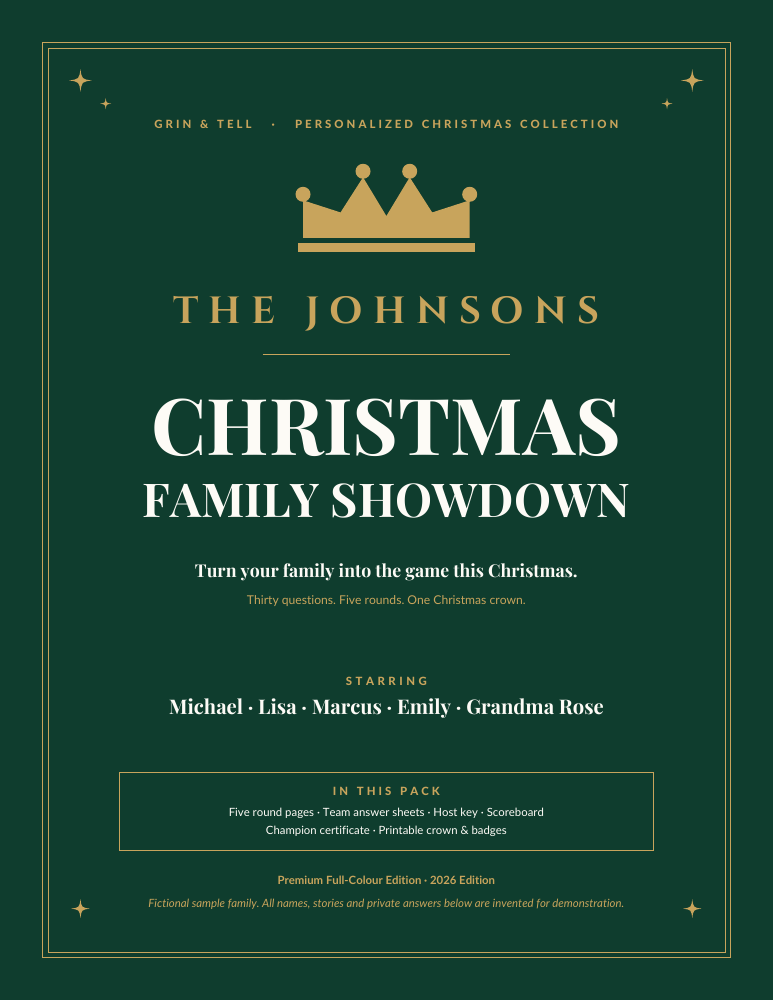
See the Christmas Family ShowdownSpecificity is the standard
There is a big difference between replacing “Player 1” with a name and actually building a question around a real story. Grin & Tell is designed around the second approach. Useful source material includes a memorable event, the people involved, what made it funny or meaningful, the phrases people used and any limits on how the story should be presented.
That information can support several different mechanics. One memory might become a “Who Said It?” question, a team guess, a superlative, a multiple-choice round or a tie-breaker. The final format depends on the occasion and the people who will be playing.
We do not invent private facts and present them as real. We do not assume a family structure, relationship history or sensitive backstory that the customer did not provide. When information is incomplete, the safer option is to use a different approved detail rather than fabricate something personal.
Keep exploring